|
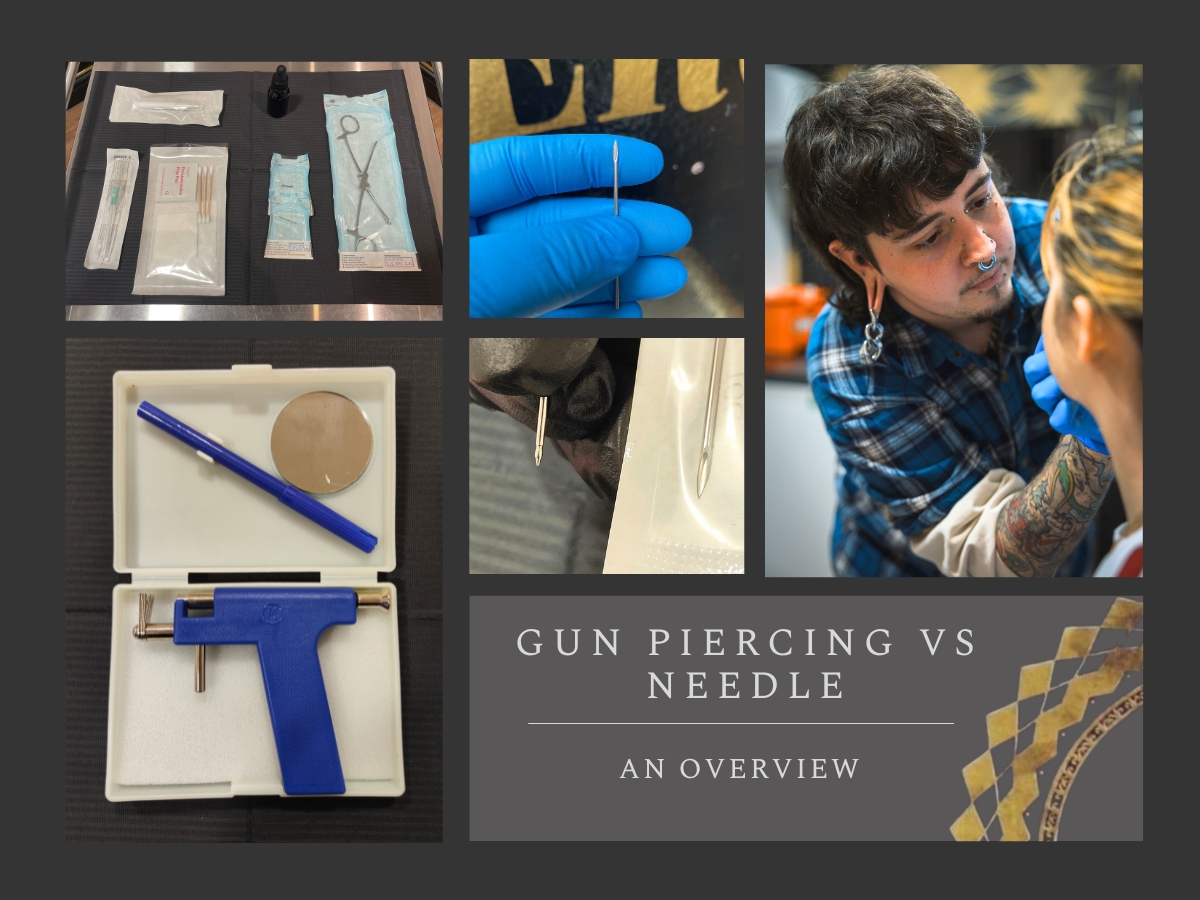
One of the most hotly debated topics within the piercing community for at least the last two decades is the differences between the ever popular gun piercing, and needle piercing. Anyone worth their salt in the piercing industry can definitely understand why a needle phobia would cause some people to balk at a needle piercing and opt for a gun. We have all been told that guns hurt less, it’s over quicker, and we all know someone who had all of their piercings performed with a gun and their piercings seemingly healed with absolutely no problems.
However, there is a much darker side to the friendly face of gun piercings. While they have remained a popular choice for parents who prefer for their children to be pierced using these seemingly innocuous gadgets, in actuality there are almost no redeeming qualities for receiving gun piercings.
Firstly, it’s important to understand that regardless of the method, piercing involves some level of trauma to the body. The procedure of piercing requires skin to be broken and causing a wound that has the potential for infection. However, there should be strict processes in place to ensure that the chance of infection is minimal from point of first contact. This means a sterile piercing environment to reduce the risk of infection during the procedure.
Any piercing has the potential for infection, regardless of how sterile the procedure might have been. This is because the time that your body maintains an open wound after a piercing can be weeks, and if an open wound comes into contact with any sort of bacteria in that time then it has the potential to cause infection. By following strict processes such as using sterile tools, sterile jewellery, and a sterile work space, we can minimise the risk of infection from the start. However once you leave the studio, the responsibility is on you to keep that risk minimal.
Needle Piercing

A conscientious and professional piercing studio will only use disposable needles in sterile packaging to perform each piercing and dispose of these needles in a sharps bin as soon as the procedure is over. A piercer will never reuse needles, which means that if you receive three piercings, three needles will be used and disposed of after each piercing, and this will minimise the risk of cross contamination from each of your piercings. All tools will come in sterile packaging, and is either reusable stainless-steel tools, or disposable tools designed for single use. All reusable tools will be placed in a solution ready for cleaning at the end of your procedure to be prepped for sterilisation, and then autoclaved (sterilised) for reuse, and disposed of in the case of disposable tools.
It is your right to ask to see any piercing tools, cleaning spaces, autoclaves, and autoclave tickets where necessary. Your studio may only be able to use disposable piercing tools, in which case they may not have an autoclave. The only time this should cause any concern is if they have metal tools such as clamps and scissors and are not using an autoclave.
The piercing itself will be smooth and quick and be performed with a steady hand and comfortable pressure. While there will be trauma to the location through the act of piercing, the sharpness of the needle is key to keep trauma to a minimum.
Another positive for having a needle piercing for those with audio sensitivity issues is the lack of jarring sounds. There may be a slight pop for cartilage piercings, but this does not compare to the noise of a gun piercing, which we will discuss further now.
Gun Piercings
Also known as hand Cartridge, hand pressure cartridges, American cartridge piercings

The social attitude around gun piercings is significantly different from needle piercings for several reasons. The consistent use of gun piercings in boutiques that are specifically marketed toward children, as well as the recent emergence of gun piercings in high street beauty shops has given the public a very lackadaisical approach to this method of piercing. Gun piercing has been available for well over 50 years now, and there were no alternatives to this method for the majority of people that wanted their earlobes pierced. It appears at first glance that this must be a safe way to pierce children and adults, because we couldn’t possibly still allow this on the high street were it not safe.
It’s this complacency around gun piercings which has allowed this practice to thrive despite heightened concerns about germs and cross contamination, a rather contradictory and concerning problem especially with the pandemic still fresh in our minds.
The first issue that has been somewhat tackled in recent years, albeit lazily, is the non-disposable cartridge guns that are still in use, even now. Cartridge guns are typically used repeatedly on many different clients throughout the day, with a cursory wipe in between to clean any visible soiling from the surfaces. Cartridge guns are not able to be autoclaved, which means these pieces are never fully sterile between uses. An alcohol wipe will never be able to access the tight spaces between the mechanisms where blood and other particulates can reach. These hidden spots are breeding grounds for bacteria, and cleaning solution simply cannot do the job that an autoclave can do. Whatever germs and bacteria, including potentially insidious infectious diseases such as Hepatitis or even HIV from previous clients will never be fully removed from these tools, and will be in contact with every other person that is being pierced with those tools going forward.

The procedure itself is significantly more traumatic on your body than a needle. The first is that the jewellery is designed to act as piercing needle as well as initial jewellery. This piece of jewellery may feel sharp to touch, but when compared side by side with a cannula needle purposefully designed for puncturing the skin, it is instantly clear that the dull point of the piercing jewellery is drastically inferior to the acute sharpness of the piercing needle.
This dull point cannot simply be pushed through skin the way that a needle can which means that piercing with this jewellery requires significant force in order to penetrate the skin. In other words, a relatively blunt object is being punched through the skin. To add to this, the jewellery is also not suitable for an initial piercing, as the post is not long enough to accommodate swelling, nor is the material satisfactory for safe healing.
Simply put, butterfly stud jewellery is not designed to safely pierce an ear, nor is it safe for healing, and one could (and would) argue that this type of jewellery is not safe for healed ears either. Butterfly studs are often made with inferior metals, included plated nickel, which can lead to severe irritation, allergic reaction, and even infection.
The danger to your body increases significantly when piercing cartilage. The blunt force trauma required to pierce cartilage can shatter the ear cartilage, causing irreparable damage through tissue damage as well as infection. A quick Google search for cauliflower ear can tell you much about the potential risks of piercing cartilage with a gun.
Add to this a lack of adequate aftercare advise, and no ongoing care from your piercer, you are left to fend for yourself with a potentially damaging piece of jewellery, and no idea how to manage issues. You may never experience any negative impact from this, but many trained and experienced piercers will ask you, is this worth the risk to save a bit of money?
Now you may be thinking that I have just written a little mini horror story, and that I might sound incredibly negative about gun piercing, as I hear so many tell me that they, or their children, had gun piercings as a child and experienced no negative effects. Great! I would never wish the problematic aftermath of a gun piercing to affect anyone. I myself had my earlobes pierced with a gun as an 8-year-old, and I now have 35mm stretch earlobes with no long-lasting issues from the procedure. But the clack of the gun, the sudden and unexpected pain, and the weeks of painful throbbing has never left my memory. I remember my earlobes being itchy and red and painful for weeks due to poorly fitting butterfly backs, as well as my aggressive nickel allergy, an experience I have never had with needle piercings and quality jewellery.
Testing a Gun Piercing Kit
For the sake of science, I decided that I would part with my hard earned cash and purchase myself one of these easily accessible gun piercing kits from an online marketplace we have all heard of. What horrified me the most was how cheap this kit was. Anyone who has access to these marketplaces can purchase one of these kits, which includes a whole host of earrings, for a whopping £6.45. And since this method is still promoted in high street shops marketed towards children, you would be forgiven for thinking this is a safe and cost effective way to give yourself a few piercings.
The package included piercing gun, an ordinary blue felt tip pen, and a tiny little mirror neatly contained inside a cheap plastic box. Separate from this was a plastic sleeve that contained roughly 40 earrings stuck in a polystyrene sheet, and a baggie of earring backs.


As you can see from these photos, nothing is sterile, there are no instructions, and no health warnings. The earrings are made from a metal of unknown composition, though from the bad quality I would hazard a guess at silver plated nickel. There was even pieces of hay that fell out of the packaging which begs the question, what else is this factory producing in close proximity to this piercing kit?
Taking a closer look at the product listing online, the word “safety” is used multiple times, alongside the word “professional” and even recommends the use of this gun on the nose. The instructions, which are only available on the product listing itself, are vague and badly translated with step one being simply “1. Please keep away from.” Very professional.
My colleagues and I were morbidly fascinated by this plastic device, so we decided to explore how to use this piece of kit, and seeing and feeling the difference to the way the blade versus jewellery move through a glove is an excellent comparison. There are dozens of excellent videos on instagram of other artists who have created similar comparisons using much better cameras than I have access to, so it’s worth checking those out online to see the huge difference between using a machined blade versus jewellery that is not fit for purpose.
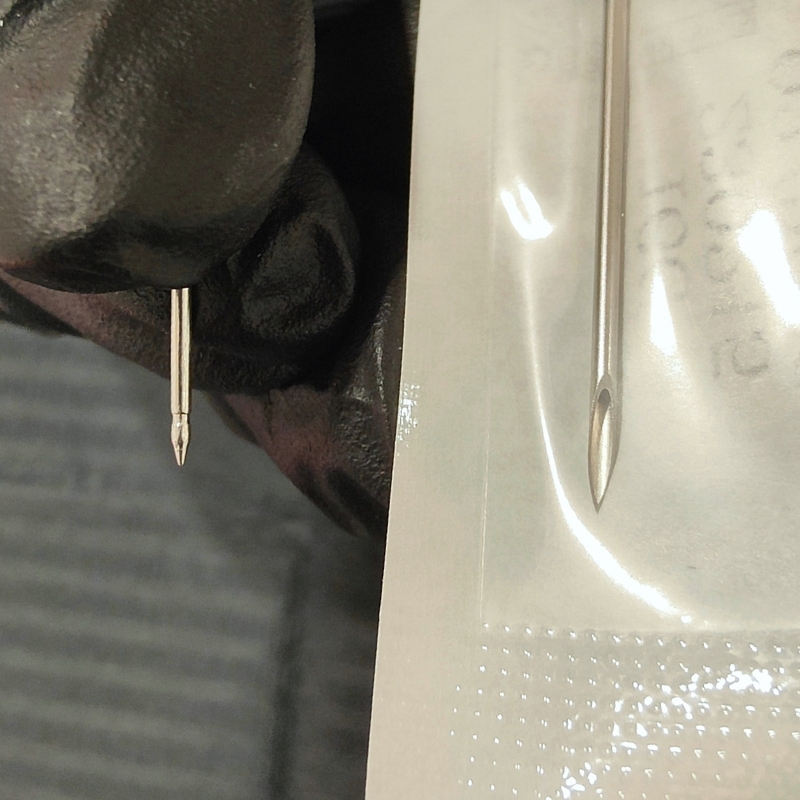
A correctly machined bevelled needle is designed in such a way as to allow a clean, curved slice through the skin, and the needle parts the skin to allow the jewellery for space. The jewellery designed for piercing guns isnt sharp enough to make this slice, so a punching action is required to get this relatively blunt (by comparison) piece of jewellery through the ear. Similarly, the control needed to make a correctly aligned and angled piercing can be easily achieved by using a needle, whereas loading the jewellery into the piercing gun, there was a noticeable descrepency with the angle that the jewellery was sitting, and no discernible or safe way to adjust this angle.
During our testing of the piercing gun (on silicone ears only), the gun jammed several times, which was incredibly difficult to unjam with just one hand. I cannot imagine how painful and stressful this would be for a client to experience this right after a piercing.
None of this is to say that needle piercing is infallible. There is always the chance for migration and rejection due to anatomy, infection from contaminants after the piercing, or irritation bumps, but by reducing the risk of infection and excessive trauma from the start of the procedure, you will give your piercing the best possible start to healthy healing.
With all this being said, it is easy to understand why unsafe methods of piercing such as gun and cartridge piercings undermine the years of experience and education that piercers go through in order to ensure our clients safety. Gun piercing puts people, particularly children, directly in the path of unsafe practices, cross-contamination, blood-borne pathogens, infection, and irreversible damage. To say that true professional piercers are resentful toward gun piercing would be an understatement, and we will continue to educate all who seek our advice on the dangers involved.
As I close this blog, I feel it is important to recognise that needles are not a guarantee that the studio using them is competent, safe, or hygienic. While the use of a gun piercing is a clear indication that the studio does not value quality, hygiene, or safety, it can be a little more difficult to discern whether a needle only studio is in fact a safer studio. Doing proper research, and reading reviews, seeing client images as well as studio portfolios is a good way to find yourself a studio that values hygiene and safety as its priority.