
|

Disclaimer – We do not claim to be medical professionals. Our advice regarding infection is based on many years of experience working with piercings. Should a doctor or nurse advise you otherwise, it is important that you always prioritise their advice over ours. This blog is not a substitute for clinical diagnosis.
Our ethos at No Divide is to provide every client with ongoing care for their piercing. Our service doesn’t end at the piercing itself, we are here to help you with downsizes, jewellery changes, ongoing aftercare, troubleshooting concerns, and offering advice to help you with the health and healing of your piercings. We always implore our customers to return to us, even if it’s for a simple checkup, as this gives you peace of mind, as well as allowing us to catch any issues early.
One common concern we see in the studio is clients that return to us woefully declaring that their piercing is infected.
“My Piercing is Infected”
However, we find that it is rarely so cut and dry with piercings. Infection and irritation can often present with the same symptoms. Heat, swelling, pain or discomfort, and oozing of fluid. The key difference between the two, however, is the consistency of that fluid. There are also a few symptoms that, due to a level of unfamiliarity with the nature of healing piercings, can be confused for infection.
I performed a quick image search to see the sort of information I might come up with when searching “infected piercings” and the results were murky at best. The majority of the images that appeared in the search showed irritation bumps, which can be confused for infection due to the appearance of what looks like pimples or pustules, but for the most part, irritation bumps do not contain fluid that can be drained. While infection and irritation bumps can present at the same time as one another, but they are mutually exclusive in terms of cause and treatment.
You may have performed the same sort of image search to determine what is wrong with your piercing and found yourself even more confused as to how to move forward with treating your piercing, so let’s break down what we as piercers are looking for when we assess the health of your piercing.
Lymph
Lymphatic fluid is part of the lymphatic system, which is present throughout the entire body, and plays a crucial part of your immune system. The lymphatic system contributes to the body’s defense against infection by filtering waste products and transporting immune cells.
You may see crust on your healing piercings throughout your healing journey, and that crust is typically lymphatic fluid, or lymph. It is a clear or yellow liquid with a thin watery consistency, and this fluid is working hard to heal and protect your body by transporting white blood cells to the piercing site.
Crust on your piercings, as well as experiencing fresh lymph is perfectly normal. This indicates that your body is working to keep your piercing clean and create its own natural barrier to keep out infection. We aid this process as best we can with a good cleaning regiment to ensure that there is as little chance as possible for infection to enter the piercing. This lymph will remain present until the channel throughout the piercing has healed sufficiently.
It is important not to pick at this crust. As stated, lymph is perfectly normal, and acts as a scab to keep foreign objects and bacteria out of a wound. The more you touch the site of the piercing, and the more you agitate this scab, the more likely it is that you will be transmitting bacteria directly into your piercing. This has led to the most commonly repeated sentence within the piercing industry; Stop touching it! As tempting as it is to touch your piercing, fiddle, twist the jewellery, pick off the scab, you are causing issues that can lead to infection, which leads us neatly onto our next section.
Pus

Pus is a clear sign of infection. It is often thick, cloudy, can vary in colour from yellow, green, and even reddish brown, and may also have an odour as it contains dead blood cells, white blood cells, and often bacteria. Pus is a sign that the body’s immune system has detected, and is fighting off an infection, with the pus itself being a byproduct of that process.
It is important to note here that pus is a serious concern and must be addressed quickly. Often, we will not be able to see that a piercing is infected until we move the jewellery to allow that pus to release, though each case of infection is different. We will be able to assess the severity of the infection and offer guidance, which may include visiting your doctor’s surgery or local hospital for antibiotics to fight that infection.
Through years of experience, we find that removal of jewellery can exacerbate an infection considerably. Removing the jewellery from an infected piercing can cause the exit wounds to close over, leading to the infection becoming trapped inside your body. As you can imagine this becomes a breeding ground for bacteria, as well as causing a painful build-up of pus and infected tissue. As long as the exit wounds are present and held open with jewellery there is access to that infection for cleaning and treatment. We may upsize your jewellery to accommodate the swelling however we will recommend you visit the hospital.
-Disclaimer – We do not claim to be medical professionals. Our advice regarding infection is from many years of experience working with piercings, however, should a doctor or nurse advise you otherwise, it is important that you always prioritise their advice over ours.
Other Infection and Irritation Signifiers
Heat – You will often find that the site of an infection feels hot to the touch. This is the body’s natural response to fighting infection, and it signifies that the body is transporting white blood cells to the area to fight the invading bacteria. This can also be a sign of irritation as the body sends more blood flow to an agitated area to try and deal with the irritation. Piercing jewellery is a foreign object which the body will identify as a reason to send more white blood cells to the area.

Swelling – With the exact same reasons as above, swelling is due to the body sending white blood cells to the area to help deal with potential infection or a foreign body. This symptom can be present with both irritation and infection, causing red and swollen skin.
Pain – This one is a broad and seemingly rather obvious entry, but I will elaborate on this one a little further as this is one is often the first and only criteria that many clients need to convince themselves that their piercing is infected. Piercings are a trauma on the body and are synonymous with pain. In the first few days you will encounter pain in the area of the piercing, which may or may not include bleeding and bruising. Pain that persists after weeks or months is often dependent on a variety of factors. Infection is not always the cause, and it may simply be repeated fiddling with the piercing, sleeping on the piercing, swapping jewellery too quickly, wearing inadequate or poor quality jewellery, or not downsizing when needed.
If you are experiencing any ongoing pain, swelling, heat, redness, or pus from your piercing we advise you to visit us in the studio so that we can determine your next steps. We will ask you questions such as your sleeping habits, how you clean your piercings, the type of jewellery you’re wearing, as well as your lifestyle. It may seem irrelevant to ask about your activities, but an avid surfer may struggle more to heal a piercer than someone who stays out of the water. We also want to see what you are experiencing. Seeing is much more effective than describing over the phone, or after a piercing has been removed. Seeing your piercing allows us to establish what is happening with much greater accuracy.
Fever
I have included this one separately as I feel this is highly important to include. If you suspect your piercing is infected and you are experiencing fever, chills, sweating, or generally feeling unwell, you must seek medical attention immediately. Fever is a clear indication of an advanced infection and we advise that you visit a hospital immediately.
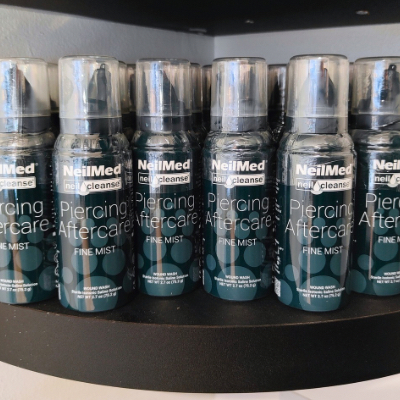
Piercings are a channel in which infection can enter the body. We want to minimise that chance as much as possible by providing you with as much information as we can. This ensures you can continue to keep your piercing, and your body, happy and healthy throughout the healing process. As discussed, lymph will often form a crust around the entry holes of the piercing, and it is crucial not to disturb this crust with your fingers, as tempting as it is.
We get it, picking the crust is satisfying, but breaking the natural protective barrier that your body has created will open your piercing up to any bacteria that may lurk on your fingers.
Clean your piercings, ideally with sterile saline to gently break down that crust rather than picking at it and avoid touching your piercing entirely until you can clean your piercing with clean hands.